For those new to Spain, do you often find yourself lingering in the refrigerated section, staring at rows of beautifully packaged sliced ham at supermarkets? It looks very convenient—ready to eat right after opening—with prices ranging from a few euros to dozens, making it dazzling but puzzling. Yet you might wonder: does this taste the same as ham freshly sliced at specialty shops? Could it be just “leftover scraps”? Today, speaking as a seasoned expat who has enjoyed ham for over a decade, let me share some insights on supermarket sliced ham.
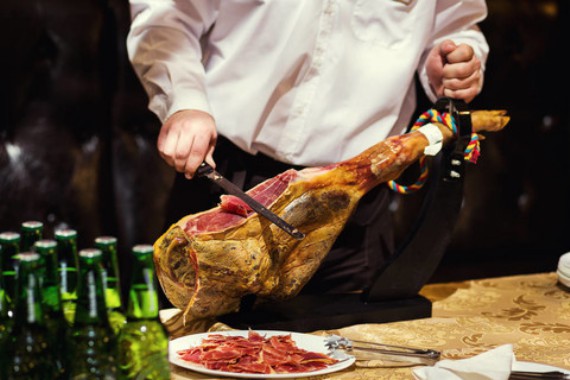
First of all, the conclusion: you can definitely buy sliced ham at supermarkets, and it’s the daily choice for many Spanish families. But the key is, you must know how to pick! Buying the right one offers great value; buying the wrong one might mislead you to misunderstand the national treasure of Spain—overly dry and salty, almost like chewing wax. To avoid pitfalls, let’s start with the basics.
Two Main Types of Ham: Iberico vs Serrano
This is the most fundamental distinction of Spanish ham hind leg. Once you understand this, you’ve already mastered half the knowledge. Simply put, Jamón Ibérico comes from Spain’s native black-hoofed pigs whose breed and farming methods are carefully regulated. Their marbling is rich and flavors complex—they are the “nobles” among hams. Meanwhile, Jamón Serrano comes from regular white pigs, produced in larger quantities and more affordable, serving as everyday staples for Spaniards. I made a simple table to clarify the differences at a glance:
| Feature | Iberico Ham | Serrano Ham |
|---|
| Pig Breed | Iberian black-hoofed pig | Common white pig |
| Characteristics | Rich fat, melts in the mouth, complex flavor | Less fat, leaner texture, straightforward taste |
| Price | Higher | Affordable |
| Labeling | Plastic tags of different colors on the legs | Usually no color tags; check name and curing time |
How to Read the “Code” on Iberico Ham Packaging?
If you decide to splurge on Iberico ham, the packaging information is even more important. Look for the color-coded tags on the packaging—that’s a legal standard, so no fakes here.
- Black Label: Top quality! 100% purebred Iberian black pigs fed on acorns in oak forests. Very limited supply, highest price.
- Red Label: Excellent! At least 50% Iberian bloodline, also acorn-fed. Great cost performance.
- Green Label: Good! Iberian pigs pasture-raised, eating grains and natural foods. Flavor and texture are quite nice.
- White Label: Entry level. Iberian pigs raised in pens, only fed commercial feed. Most affordable, but flavor is less impressive.
So, next time you see a pack of Jamón de Cebo Ibérico in the supermarket, you’ll know this is the entry-level model of Spanish ham front and hind leg Iberico ham.
The “Pitfalls” of Sliced Ham and Buying Tips
To be honest, any pre-packaged sliced ham cannot match the flavor of freshly sliced ham. That’s because the fat and aroma of ham quickly oxidize once exposed to air. So when Spanish ham hind leg is sliced by machines and vacuum-packed, there’s inevitably some flavor loss. However, this minor sacrifice is acceptable for convenience. My advice is:
- Check the date: Try to buy ham with the most recent production date.
- Check the condition: Good sliced ham will look oily and translucent at room temperature. If it looks dry, the quality might be average.
- First time try: Start with green label Cebo de Campo or red label Bellota—these ensure quality and reasonable prices. No need to chase the most expensive black label
unless you have money to burn.
In conclusion, supermarket sliced ham is a convenient gateway to explore Spanish cuisine. With basic knowledge, you can spend appropriately and buy flavors that satisfy you. What brands do you usually buy? Feel free to share your thoughts below!
