For friends new to Spain, does walking into a supermarket or market stall leave you stunned by rows of magnificent hams? That was definitely me when I first arrived—looking at those glossy big legs, mouth watering, yet clueless about where to start. Each looks almost the same, but prices vary enormously. After some research and a few costly lessons, today I want to talk about what is known as Spain’s national treasure—the Iberian Black Pig hind leg ham.
What Exactly Is Iberian Ham?
First, you should know that top-quality ham generally refers to Jamón Ibérico, which is Iberian ham. It comes from the hind legs of Spain’s unique Iberian black-hoofed pig. These pigs have black hair and black hooves and roam freely on the dehesa oak pastures. Their body fat seeps into the muscle, creating beautiful marbling patterns. This is entirely different from the more common and affordable Serrano ham you might be familiar with; the taste and aroma are worlds apart.
The “ID Card” of Ham: Understanding Label Colors
To avoid being misled, the easiest and most straightforward way is to check the color of the plastic tag attached to the pig’s hoof. This is the Spanish ham hind leg official government grading system, like an ID card that cannot be faked. In simple terms, from highest to lowest, there are four types:
| Label Color | Breed Purity | Feeding Method | Common Name |
|---|
| Black | 100% Iberian Black Pig | Acorn-fed | Bellota Ham |
| Red | 50% or 75% Iberian Black Pig | Acorn-fed | Acorn Ham |
| Green | Over 50% Iberian Black Pig | Grazing + Grain feed | Cebo de Campo Ham |
| White | Over 50% Iberian Black Pig | Grain feed | Cebo Ham |
In a nutshell: Black > Red > Green > White. Remembering this basically ensures you won’t make a wrong purchase! The black label denotes the top-tier “Pata Negra,” the Rolls-Royce of hams.
Home Buying and Tasting
If your household is large or you often have guests, buying a whole leg is actually the most cost-effective, and Spanish front and hind leg ham slicing has a special ritualistic charm. You’ll need a ham holder and a dedicated long knife to slice it yourself at home; the flavor beats any pre-packaged cuts. Just be mindful that once the whole leg is sliced, it should be consumed quickly because the cut surface dries and hardens. If you only want to taste occasionally, vacuum-packed slices are far more convenient.
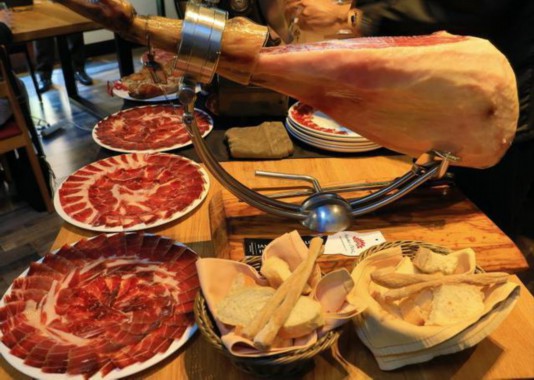
Finally, how to eat it. The most authentic way to enjoy top-grade Iberian ham is straight up! Never eat it immediately after refrigeration; let it come to room temperature so the fat softens slightly, displaying a translucent sheen. At this point, take a slice by hand and pop it in your mouth. The acorn aroma and rich meaty flavor instantly explode, with the fat being smooth and melting in your mouth—an absolutely wonderful sensation. Enjoy it with a glass of Rioja red wine or a small piece of toasted bread for a truly authentic Spanish taste. I’ve heard some use it for cooking, but that’s such a waste!
Which brand or grade of ham do you usually prefer? Any experiences with poor buys or great bargains? Feel free to share your stories below!
