Hello everyone! Recently, I finally made the decision to purchase my very first whole leg of Jamón, and I was really excited! But just as I was about to “open the leg,” I encountered a frustrating problem: the outermost layer of the ham’s skin is dry and hard like a suit of armor, and the Spanish ham skin mold issue along with the yellow fat layer underneath and even the red lean meat are all tightly stuck together, making it difficult to pry apart even with a knife. I wanted to ask the experienced members of the forum: is this normal? Did I get a defective product?
After some research and consulting with local friends, I finally understood. It turns out that this is actually a perfectly normal phenomenon, and can even be seen as a sign of proper craftsmanship during the long drying and curing process of the ham. During curing, the ham loses a large amount of moisture, and the outermost layer loses water first, forming a hard, dry protective layer that firmly locks in the flavor and moisture of the meat inside. So, if you encounter this issue, don’t panic, this is not a bad thing!
Actually, it’s quite simple—the key is to “only handle the part you’re going to eat.” Never try to peel off the entire skin of the whole leg at once! The correct approach is to decide which part you want to slice today, then use a small, sturdy boning knife to deeply carve a V-shaped cut along the area you will be cutting.
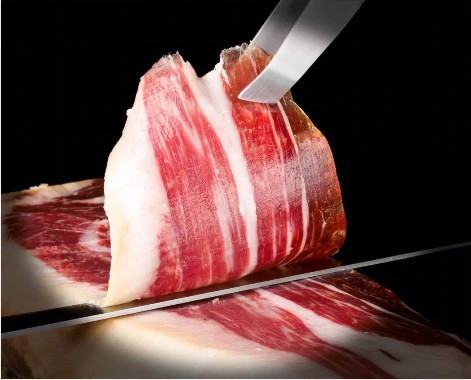
Then, you can follow this cut to remove the hard skin and the yellowish, rancid-smelling fat underneath together until you expose the white or pink quality fat and red lean meat below. This way, you have a clean cutting surface to start enjoying slices of ham.
Common Mistakes
To help everyone understand more intuitively, I made a simple table summarizing common beginner errors:
| Wrong Approach | Correct Advice |
|---|
| Trying to slice skin and meat together | You must first remove the hard skin and yellow fat of the part you will cut |
| Peeling off the skin of the entire leg at once | Peel as much as you eat. Otherwise, the remaining meat will dry out quickly |
| Using a thin long slicing knife to remove skin | Use a small, sturdy boning knife for safety and ease |
| Throwing away the removed yellow fat | You can save it to smear on the cutting surface for moisture retention |
The skin tightly adhering to the meat is a sign of good ham curing. As long as you use the right method, it is not complicated to handle. I hope my small experience can help other beginner friends! If you have any unique tips when handling ham, feel free to share! Wishing everyone a joyful ham carving and a delicious meal!
