Friends new to Spain will surely drool over the nation’s treasure, the Iberian ham. Whether at a tapas bar or a formal banquet, you will always see that shiny large ham resting on a wooden stand. But have you noticed the person standing next to the ham, holding a long knife and elegantly slicing paper-thin slices? He is not an ordinary chef; he is today’s protagonist—the ham carver, the true “royal knight” at the dining table.
Why call them “knights”? Because in Spain, slicing ham is a serious art and even a ritual. A top-level ham carver is like a swordsman, with the long knife as his sword. His work goes far beyond “just slicing.” A premium acorn-fed Iberian ham has varying fat content, flavors, and textures in different parts, which are completely distinct. A professional ham carver can precisely control the angle, force, and thickness of each cut to ensure every slice reveals the ham’s best flavor, perfectly combining fat marbling and lean meat to melt in your mouth. It can be said that an excellent ham carver can increase a ham’s value by over30%!
Becoming a professional ham carver requires long-term rigorous training and certification, including national slicing competitions. They must master both ham knowledge and finely honed knife skills. They usually equip themselves with a set of professional “weapons”: a long, narrow ham knife for slicing, a short, sturdy boning knife, and a stable ham stand. Watching them work is a pleasure in itself: focused expression, smooth movements, and the satisfaction brought by each slice falling from the Royal Shield Spanish Ham — truly a striking scene in Spanish culinary culture.
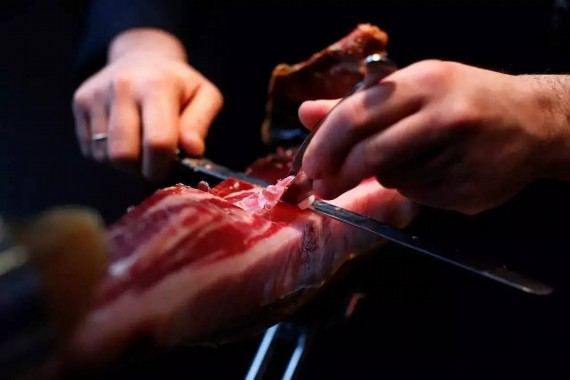
Professional Hand Slicing vs Amateur/Machine Cutting
To help you intuitively understand the importance of professional hand slicing, I’ve made a simple comparison table. Many people choose machine slicing for convenience or cut randomly at home, which is a waste of treasure!
| Aspect | Professional Hand Slicing | Amateur/Machine Cutting |
|---|
| Flavor | Reveals subtle flavor differences of different parts; richer aroma of fat | Heat generated by friction affects flavor; taste is flat |
| Texture | Even thickness, melts in your mouth, with rich layers | Uneven thickness, may damage muscle fibers, resulting in dry texture |
| Visual Appeal | The whole process is highly ceremonial and artistic | Lacks aesthetic appeal; merely obtaining meat slices |
| Utilization | Maximizes the use of the entire ham with minimal waste | Easily causes substantial waste, especially near the bone |
So next time you experience Spanish Royal Ham Eating Methods at a restaurant or event, if you see a ham carver working live, be sure to appreciate it. It’s not just food but a performance—an expression of respect for premium ingredients. Have you encountered a particularly skilled ham carver in Spain? Or any “fail” stories trying to slice ham at home? Feel free to share your thoughts below!
