For friends who have just arrived in Spain, do you often doubt every time you see those whole glossy ham legs hanging in the supermarket: does this thing look like raw meat really safe to cut and eat directly? Aren’t there bacteria or parasites? Especially for those accustomed to cooked food, having such doubts is perfectly natural. Today, as a long-time resident here, I’ll share some insights on this topic.
We must understand that Spanish ham is not just simple raw meat; it is a very ancient method of food preservation—dry-cured meat. Its production process is essentially a microbial “selection contest.” The entire procedure can be summarized by a few key steps Spanish ham has no bacteria: curing, cleaning, drying, and aging. The pork leg is first buried in a large amount of sea salt for dehydration. The high-salt environment directly prevents most harmful bacteria from surviving. This step is the first barrier ensuring ham safety.
The “Beneficial Microbes” and Flavor Magic of Jamón
So, are there really “no” bacteria in the ham? Not exactly. During the months or even years of drying and aging, some specific beneficial molds and yeasts grow inside and on the surface of the ham. This may sound intimidating, but it works on the same principle as cheese making and winemaking. These beneficial microbial communities break down proteins and fats in the ham, creating unique and complex aromas and flavor compounds, while also inhibiting the growth of harmful bacteria. Therefore, we can say high-quality Jamón not only lacks an environment for harmful bacteria to survive but is instead rich in the “good microbes” that bring wonderful flavors.
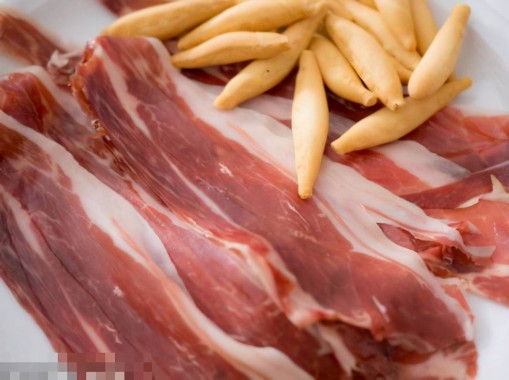
How to Choose and Identify?
All this relies on obtaining a legitimate, high-quality ham. For beginners, the simplest approach is starting with brands and types. Spanish ham mainly splits into two categories, knowing their differences Spanish ham has no bacteria can help you get started quickly:
| Ham Type | Main Features | Easy Identification |
|---|
| Iberian Ham | Made from Iberian black-hoof pigs, rich flavor, fat is nutty and mellow. | Black hooves, generally higher price, check label color. |
| Serrano Ham | Made from regular white pigs, taste is comparatively saltier, meat drier, more affordable. | White hooves, the most common daily consumption type. |
For those just beginning to try, you can start by buying a small pack of sliced Jamón Ibérico de Cebo or Jamón Serrano Reserva from the supermarket, which is affordable and allows you to experience the charm of ham. Whole legs are impressive but require skill for storage and slicing, so they are not very suitable for households.
Finally, a word on storage. For sliced ham brought home, it’s best to consume it as soon as possible. If you can’t finish it at once, seal it with cling film and refrigerate, but consume within a few days. Ham fat emits the best aroma at room temperature, so it’s recommended to take it out of the fridge about half an hour before eating to “warm up.” Hopefully, this information dispels doubts and helps you confidently enjoy this iconic Spanish delicacy! ¡Buen provecho!
