When I first arrived in Spain, I thought ham was just a piece of dried salted meat until a friend took me on a tour of a ham factory, completely changing my perception. The room filled with hanging hams and the unique aroma in the air was an absolute sensory feast! It turns out that a top-quality Spanish ham involves such a complex and artistic curing process. Today, I’d like to share the essence behind it.
Four Core Steps of Spanish Ham Curing
An ordinary pig’s hind leg transforms into an artistic masterpiece on the dining table through four long and crucial stages. Every stage demands meticulous control of temperature and humidity; truly, it’s the art of time.
Step One: Salting
This is the foundational aspect that determines the flavor and preservation success of the ham, as defined by the Spanish ham slicing technique. Fresh pig legs are fully covered with coarse sea salt and buried. Salt’s role goes beyond seasoning; it uses osmotic pressure to dehydrate the ham and inhibit microbial growth. Depending on the leg’s weight, this process usually lasts one to two weeks. The salting duration must be precisely calculated—a day too long makes it too salty, a day too short risks spoilage.
Step Two: Resting and Drying
After salting, the ham is cleaned and moved to a low-temperature, high-humidity room for “resting.” This stage allows the salt to penetrate uniformly inside the leg. Then, the ham is transferred to a well-ventilated drying room for several months. Here, moisture continues to evaporate, and fats undergo fascinating chemical changes, gradually forming a unique aroma.
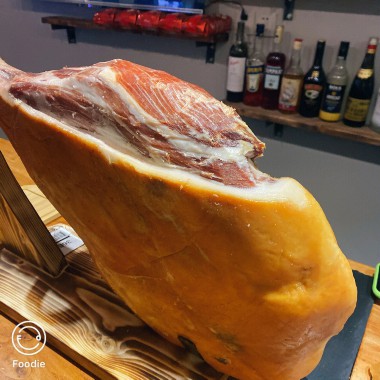
Step Three: Cellar Aging
This is the most magical and longest stage! The dried ham is sent to a cellar for aging. Under constant temperature and humidity, proteins and fats inside the ham slowly break down through microbial enzymes, producing numerous complex aromatic compounds. This phase can last from one to as many as four or five years. The ham’s flavor and texture reach their peak here, fully showcasing the Spanish ham slicing technique. The longer the aging, the richer and more complex the flavor, and the pricier it gets.
To provide a clearer comparison, here is a simple table contrasting the two most common types of ham:
| Feature | Iberian Ham | Serrano Ham |
|---|
| Pig Breed | Iberian Black Pig | Common White Pig |
| Farming Method | Mainly acorns and pasture-raised | Grain-fed in enclosures |
| Fat Distribution | Marbled within muscles | Thick fat layer, separate from muscle |
| Curing Time | 24 - 48 months or longer | 12 - 24 months |
| Flavor | Nutty aroma, complex taste, oily | Salty and straightforward, drier texture |
Every slice of delicious Spanish ham carries the dedication of artisans and the passage of time. Which type of ham do you usually prefer? Have you ever tried curing your own bacon or sausages at home? Feel free to share your experiences!
