Hello everyone! I just came back from Mercadona, feeling a bit overwhelmed. I originally wanted to buy a good ham to gift a friend, but when I arrived at the ham counter, I saw all those ham legs wrapped with plastic rings of various colors—black, red, green, white… I was instantly faced with a tough choice.
I wanted to ask the experts in the forum: what are these colorful labels for? Do they have any significance? Or are they just decorations made by merchants for appearance?
After some “hard” online research and learning, I finally understood! It turns out this small colorful label is the official “ID card” of Jamón Ibérico! It’s not just a decoration but a mandatory regulation introduced by the Spanish Iberian Pork Industry Association to guarantee the quality, lineage, and feeding methods of the ham. With it, consumers can shop with confidence and won’t be deceived anymore.
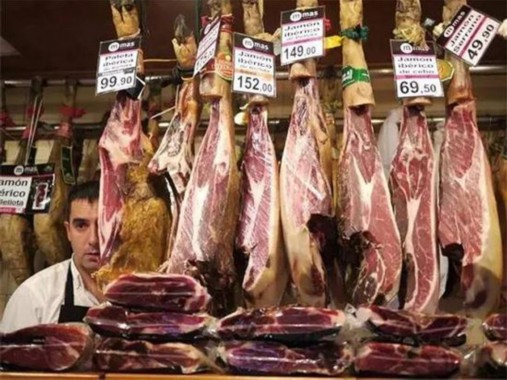
Understanding the Four Colors: Easily Choose Your Jamón Ibérico
Simply remember the ranking order: “black > red > green > white.” Below, I break it down in detail:
Black Label
This is the highest grade of the Spanish ham label, the “Rolls-Royce” of hams! The black label means the ham comes from 100% purebred Iberian pigs raised free-range during acorn season, with acorns as their main food. With pure lineage and 100% natural acorn feeding, its flavor and texture are top-tier, and naturally, it is the most expensive. If you want to experience the most authentic Jamón Ibérico, choosing the black label blindly is a safe bet!
Red Label
The red label is also excellent, just one step below the black. It indicates the pig breed is 50% or 75% Iberian blood, but it’s also raised free-range during acorn season and fed mainly acorns. Although the lineage isn’t 100% pure, the feeding method is the same as the black label hams, so the flavor is also outstanding, with a better value for money. Perfect either as a gift or for personal consumption.
Green Label
The green label’s official name is “Cebo de Campo.” It means the pig’s bloodline is 50%, 75%, or 100% Iberian, but the raising method is “semi free-range.” This means the pigs grow outdoors eating some pasture and plant tubers, supplemented with grains and legumes. The flavor is better than fully grain-fed, and the price is more budget-friendly.
White Label
The white label is the entry-level Jamón Ibérico, officially called “Cebo.” The pig’s lineage is 50%, 75%, or 100% Iberian, but they are farm-raised in enclosures and fed entirely on grains and legumes. This is the most common type of Iberian ham found on the market under the Spanish ham label colors, being affordable and suitable for daily consumption. For example, a broke student like me often buys this one for everyday snacks.
To make it easier to remember, I compiled this table:
| Label Color | Official Name | Lineage Purity | Feeding & Raising Method |
|---|
| Black | 100% Ibérico de Bellota | 100% Iberian | Acorns, free-range |
| Red | Ibérico de Bellota | 50% or 75% Iberian | Acorns, free-range |
| Green | Ibérico de Cebo de Campo | 50%, 75%, or 100% Iberian | Feed supplemented, free-range |
| White | Ibérico de Cebo | 50%, 75%, or 100% Iberian | Feed, farm-raised enclosed |
Finally, a reminder that this four-color label system is exclusive to Jamón Ibérico. The cheaper Jamón Serrano we often see in supermarkets does not have this system, so don’t confuse the two.
Now that it’s all clear, next time you buy ham you’ll know exactly how to choose! Which label do you usually buy? Has anyone tried the legendary black label? Share your experience!
