Having been in Spain for a while, many people like me are probably used to seeing rows of large ham legs hanging in restaurants and bars. But every time I see that glossy cut surface and the high price, I can’t help but wonder: why is this so expensive, and why does it taste so good? Today, let’s have a purely casual talk and dig into the secrets behind Spanish ham.
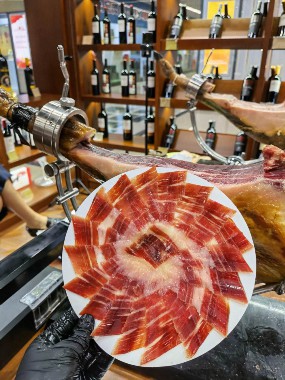
First, a head start from “the pig’s” genetics
The key to delicious Spanish ham starts with the pig itself. Especially for top-grade Iberian ham, it uses Spain’s exclusive Iberian black-hoof pig. This pig has black hair and black hooves, hence the nickname “Pata Negra.” The most remarkable aspect is its genetics, which allow the fat to evenly infiltrate muscle fibers, creating beautiful marbling. This is incomparable to ordinary white pigs, resulting in a significantly superior texture.
Second, what the pigs eat matters
Good lineage alone isn’t enough; diet is king. For top-tier Iberian ham, before becoming ham, the pigs go through a free-range period called “Montanera.” Every autumn, they roam freely in the Dehesa grasslands—a savannah filled with oak trees—feeding mainly on fallen acorns. Pigs fed heavily on acorns develop fat with a unique nutty aroma. Moreover, high-quality Spanish ham contains oleic acid similar to that in olive oil. Some even joke that premium Spanish ham is a “walking olive tree.” Truly, these pigs live better than humans.
Third, the art of time and wind
Once the pigs are chosen and fattened, the long production process begins. This process is entirely natural. First, the ham is cured with sea salt, then washed, followed by a long drying and maturation phase. The whole ham is hung in specialized cellars where temperature and humidity are controlled by adjusting window openings. The ham slowly dehydrates, ferments, and matures in the natural wind. This process can last from one or two years up to four or five years. Time gives the ham its complex, deep, and rich flavor—something no rapid method can replicate.
Finally, understanding ham grades at a glance
After all this, how do you choose ham in supermarkets or restaurants? Simply check the label color. Officials have set four grades for Iberian ham, summarized in the following simple table for clarity:
| Label Color | Grade Name | Bloodline Requirement | Feeding Method |
|---|
| Black | Bellota 100% Ibérico | 100% purebred Iberian pig | Free-range with acorns and natural pasture |
| Red | Bellota Ibérico | 50% or 75% Iberian bloodline | Free-range with acorns and natural pasture |
| Green | Cebo de Campo Ibérico | Over 50% Iberian bloodline | Compound feed + pasture grazing |
| White | Cebo Ibérico | Over 50% Iberian bloodline | Compound feed in closed pens |
A top-quality Spanish ham is the crystallization of excellent breed, all-natural food, and long time. It is not just food but also a representation of culture and craftsmanship. Which type of ham do you like the most? Or do you have any recommended brands? Feel free to leave your comments below for discussion!
