When I first arrived in Spain, I always thought ham meant those cheap pre-sliced pieces from the supermarket—salty but nothing special. Later, a friend took me to a ham shop and gave me a lesson, and that’s when I realized how deep this subject really is! Today, from the perspective of a casual foodie, I want to share with you how a top-quality Iberian ham transforms from a pig’s leg into an artistic masterpiece on the dining table.
Step One: Raising the Pig
Everything starts with a happy pig. The finest Iberian ham uses the unique Iberian black-hoof pig native to Spain. These pigs are not confined; they roam freely in vast oak groves, feeding mainly on acorns. Every autumn, when the acorns mature, it’s their fattening season. These acorns impart the ham with its distinctive nutty aroma and melt-in-your-mouth fat. Truly, without a happy upbringing, there’s no top-quality ham.
Step Two: Salting and Balancing
After the pig legs are trimmed and cooled, they enter the critical salting stage. Workers completely cover each leg with sea salt to dehydrate and preserve it. This process demands precise control of temperature and humidity, with duration generally depending on the weight of the leg—usually one day per kilogram. Too long results in oversalting; too short risks spoilage—it all depends on experience. After curing, the excess salt is washed off, preparing the legs for the next phase.
Step Three: Air-Drying and Aging, The Art of Time
The washed hams are hung in ventilated drying rooms to begin the long journey of air-drying and aging. This process typically takes several months. As the seasons change, the ham’s internal moisture gradually evaporates, while fat slowly permeates the muscle fibers, creating beautiful marbled patterns. This slow, fascinating chemical reaction is the core stage where the ham’s flavor develops.
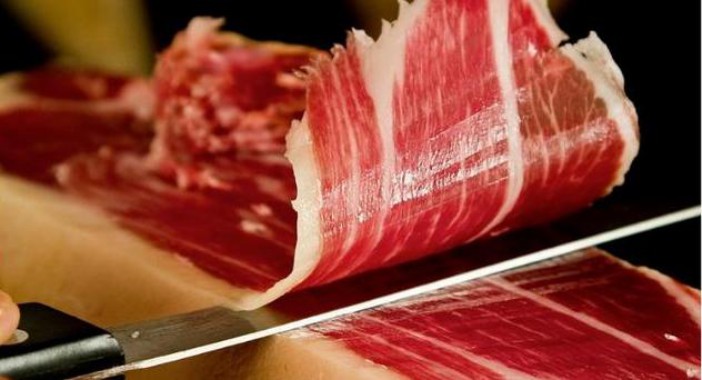
The entire procedure is truly an art of time that cannot be rushed. Different quality grades require varying aging periods.
Typical Ham Aging Duration Reference
| Grade | Variety | Minimum Aging Time |
|---|
| Bellota 100% Ibérico | 100% Purebred Iberian Acorn-Fed Ham | 36 months |
| Cebo de Campo Ibérico | Iberian Free-Range Farmed Ham | 24 months |
| Jamón Serrano | Serrano White Pig Ham | About 12 months |
Step Four: Cellar Aging, The Flavor Enhancement
In the final step, the hams are moved to temperature- and humidity-controlled underground cellars for last-stage aging. Here, a harmless layer of mold develops on the ham’s surface, acting as a protective film that helps the ham develop more complex and profound aromas. Experienced ham masters use a slender bone needle to pierce different parts of the ham and assess its scent through the Jamón production process in Spain to judge if it has reached the optimal state. So when you see a bit of mold on the ham in the method of Spanish ham production, don’t be afraid—that’s the essence.
After going through all these rigorous steps, a perfect Spanish ham is finally born. So, the making of Spanish ham teaches us that behind every pricey slice lies a dedication to tradition and respect for time. What’s your favorite type of ham? Feel free to share your thoughts in the comments below!
