When I first arrived in Spain, every time I entered a supermarket or market and saw row upon row of shiny, aromatic large hams, I was completely baffled. What is Serrano, what is Ibérico, and all those colorful labels with wildly different prices — it felt like a deep ocean! Later, guided by local gourmets, I gradually figured it out. Today, I’ll share how you can, like a local, use your culinary knowledge to “trade” for that most sublime bite of ham.
How well do you know the “secret language” of ham?
First, you must understand the basic classification. Spanish ham mainly falls into two types: Serrano ham and Iberian ham. The former is made from ordinary white pigs and is the everyday table ham; the latter is made from precious Iberian black-hoofed pigs and is the “Rolls-Royce” of hams. Within Iberian ham, there are even more subtleties, primarily determined by the pig’s feeding methods, which directly influence the ham’s grade and price. To make it clear, the government introduced a four-color labeling system:
| Label Color | Spanish Term | Feeding Method | Purity Requirement |
|---|
| Black | Bellota 100% Ibérico | 100% purebred black pigs, free-range in oak forests | 100% |
| Red | Bellota Ibérico | Crossbred black pigs, free-range in oak forests | 50% or 75% |
| Green | Cebo de Campo Ibérico | Crossbred black pigs, semi-free-range | At least 50% |
| White | Cebo Ibérico | Crossbred black pigs, farmed indoors | At least 50% |
In short, follow the colors — black is the highest grade!
The “unspoken rules” for buying ham
After understanding the classifications, where you buy is also crucial. For the best experience, I recommend going to specialized ham shops. The experts there can recommend based on your preferences, and the most important thing is they offer Spanish ham food pairings and Spanish ham culinary recommendations with freshly sliced ham! Machine-sliced ham heats up due to high-speed machines, damaging the flavor and texture. Only hand slicing guarantees wafer-thin slices that melt in your mouth. Remember, never take the easy way and buy vacuum-packed, machine-sliced ham from supermarkets; that wastes the ham’s true value.
The true “gourmet exchange for ham”: tasting and pairing
The essence of “gourmet exchange for ham” lies in the word “tasting.” When you learn how to appreciate it, every penny is worth it. The top-tier Bellota ham is best enjoyed plain, allowing it to sit briefly at room temperature so the fat slightly melts, releasing a complex aroma blending nuts and pasture.
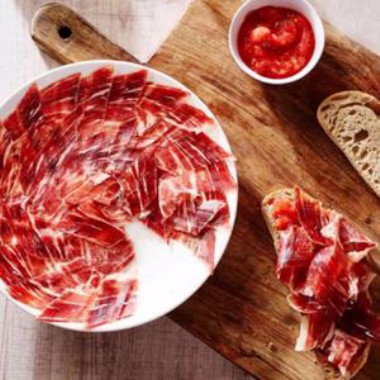
Pairings are also important. A slice of rustic bread toasted to slight crispness, spread with fresh crushed tomato and extra virgin olive oil, topped with a slice of ham — that’s the classic Pan con tomate y jamón. Or enjoy a dry sherry; the wine’s crispness perfectly balances the ham’s richness and elevates the aroma to a new level. This is true enjoyment!
In Spain, ham is more than food; it is a lifestyle philosophy. From selection, slicing, to tasting, each step is full of joy. I hope this little guide on Spanish dry-cured ham can help everyone. Feel free to add your favorite ham shops or pairing tips below so we can all share and enjoy ham more wisely and happily!
